The Grid Is Drowning in Data. Physics-Informed AI Is the Lifeline
Pleased to share my new paper just published in Frontiers in Artificial Intelligence: "Hybrid physics-informed artificial intelligence for high-fidelity modeling and optimization of electrical systems."
The U.S. grid is absorbing unprecedented load growth from AI training clusters, hyperscale data centers, transportation electrification, and industrial reshoring - at the same time inverter-based resources and extreme-weather stress are reshaping bulk-system dynamics. The EIA's Annual Energy Outlook 2025 and Short-Term Energy Outlook project record U.S. electricity demand through 2026, while the IEA's Energy and AI report sees data-center consumption roughly doubling to 950 TWh by 2030. EPRI's joint Powering Intelligence analysis with Epoch AI warns that training a single frontier model could exceed 4 GW by decade's end - pressure now reflected in FERC's recent order to PJM on co-location and large-load interconnection and in NERC's 2025 Industry Recommendation on Large Load Interconnections.
Against that backdrop, traditional black-box machine learning is hitting hard limits: models that ignore Maxwell's equations, thermodynamics, and circuit physics generate non-physical predictions, generalize poorly under transient conditions, and demand labeled datasets we cannot obtain from safety-critical assets. Physics-Informed Machine Learning (PIML) flips that paradigm. By embedding governing physical laws directly into neural network architectures and loss functions - an approach EPRI's Open Power AI Consortium is now scaling across utilities - PIML delivers white-box, interpretable surrogates that are data-efficient, physically consistent, and deployable in real time.
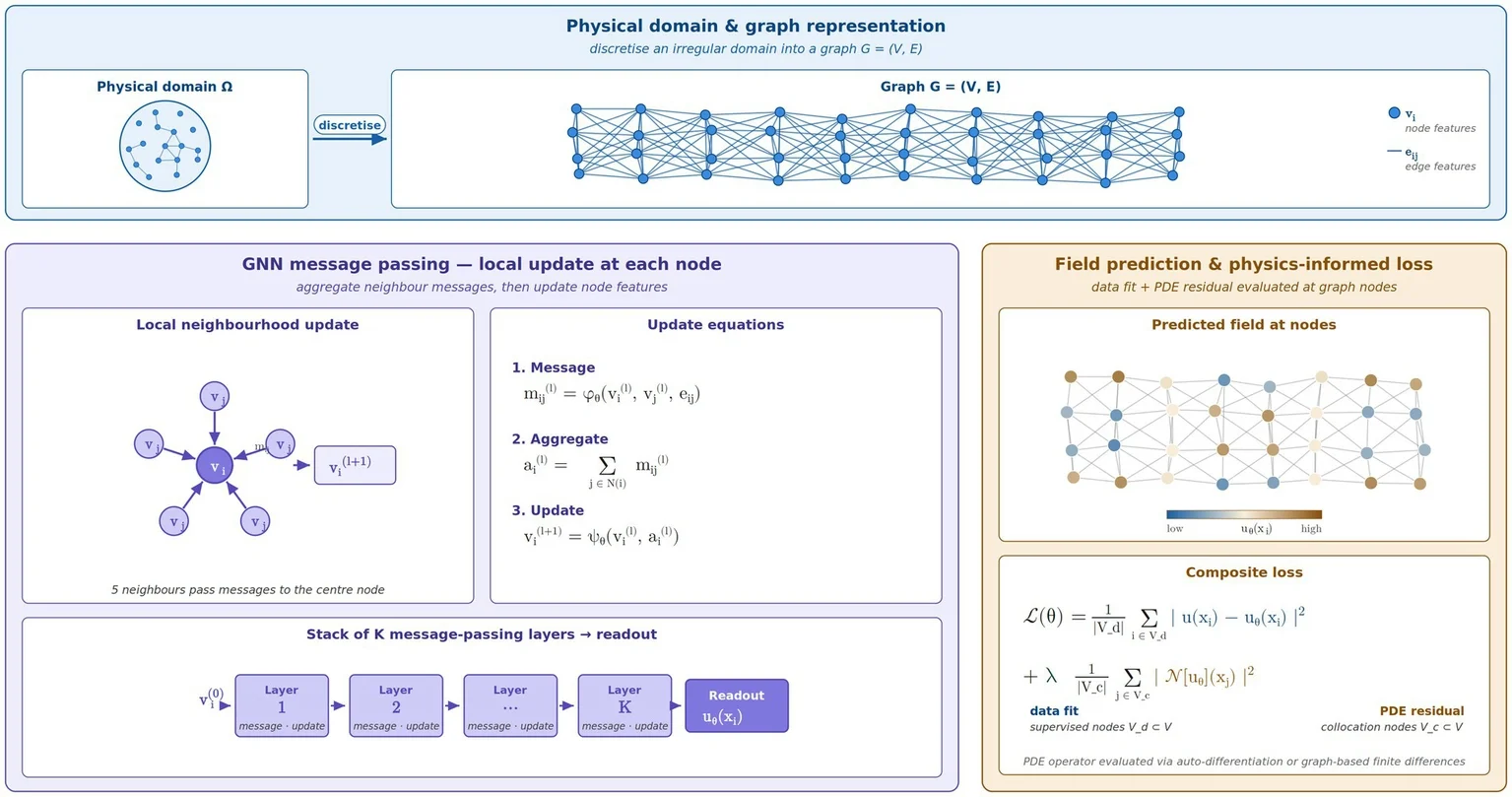
The paper synthesizes the state of the art across hybrid architectures - PINNs, PIGNNs, DeepONets, Fourier Neural Operators, and domain-decomposition PINNs - applied to online parameter identification under saturation and hysteresis, adaptive and model predictive control of drives, real-time digital twins and fault detection, and multi-fidelity surrogate optimization. Across surveyed case studies, results show that PIML consistently delivers faster convergence, lower data requirements, and stronger extrapolation than purely data-driven baselines.