
Dr. Nyangon Co-Authors New E-Book on the EU’s Carbon Border Adjustment Mechanism
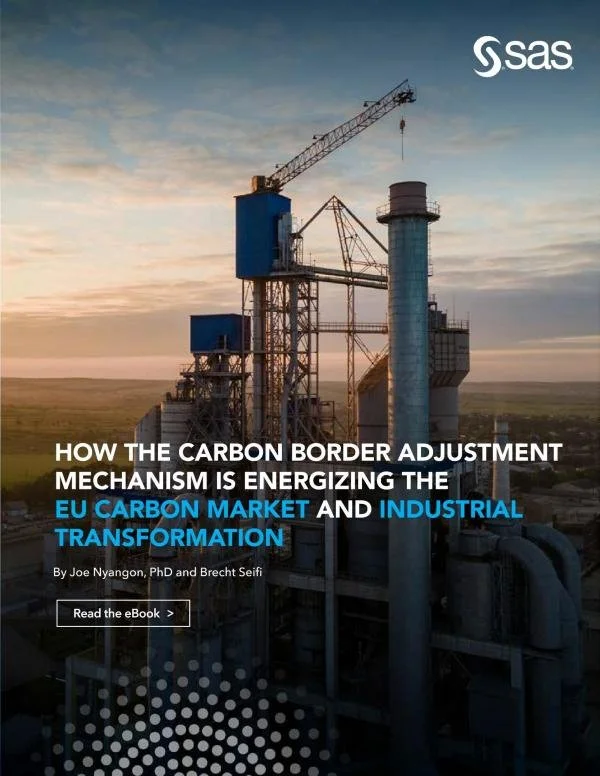
Dr. Joe Nyangon has co-authored a new e-book that demystifies the Carbon Border Adjustment Mechanism (CBAM), the European Union’s flagship policy designed to align climate ambition with global trade. Titled “How Carbon Border Adjustment Mechanism is Energizing the EU Carbon Market and Industrial Transformation,” the publication provides a rigorous yet accessible examination of one of the most consequential climate policy innovations of the decade.
CBAM: A New Frontier in Climate Policy
CBAM is set to redefine the European Union's approach to carbon emissions. By imposing a carbon tax on imports of specific carbon-intensive products, the EU aims to mitigate carbon leakage and foster equitable competition. This mechanism ensures that external producers adhere to similar standards as domestic producers, who are already under the EU's Emissions Trading System and decarbonization directives.
As global carbon markets remain fragmented and data limitations persist, investors, policymakers, and industrial stakeholders face growing uncertainty around carbon pricing, competitiveness, and transition risk. The e-book situates CBAM within this complex landscape, explaining how it operates in parallel with the EU Emissions Trading System (EU ETS) to address carbon leakage and international competitiveness challenges.
The authors detail how CBAM will gradually replace free EU ETS allowances by levying a carbon price on imports of emissions-intensive goods, including electricity, fertilizers, cement, aluminum, and steel. By mirroring EU ETS carbon costs at the border, CBAM aims to protect the integrity of EU climate action while incentivizing cleaner production globally.
Beyond policy design, the e-book delivers empirical and analytical depth, including stylized facts on EU emissions by country and industry, econometric analysis of carbon leakage effects, and emerging analytics opportunities tied to carbon monitoring, reporting, and pricing.
This publication is a timely resource for anyone navigating the intersection of climate policy, global trade, and the transition to a net-zero economy.
How Carbon Border Adjustment Mechanism is Energizing the EU Carbon Market and Industrial Transformation
In the face of climate change, the defining challenge of our era, the European Union is taking a bold step forward with the introduction of the Carbon Border Adjustment Mechanism (CBAM). This innovative policy is set to revolutionize the way carbon emissions are accounted for in trade, and it's the focus of this compelling e-Book authored by Dr. Joe Nyangon and Brecht Seifi of SAS Institute.
The First Reporting Phase: A New Era Begins
As of October 1st, the CBAM has entered its first reporting phase. This marks the beginning of a significant shift in how businesses interact with the EU market. From 2024, firms will be required to report the embedded emissions in their products, and by 2026, they will need to financially account for the carbon content of their imports.
A Resource for the Future
This e-Book is not just a timely resource; it's a roadmap to understanding and navigating the upcoming changes. Dr. Nyangon and Mr. Seifi delve into the stylized facts of CBAM, providing a detailed analysis of EU emissions by country and industry, and examining the econometric implications of Carbon Leakage Effects.
What exactly CBAM is about.
The stylized facts of CBAM and EU Emissions by country and industry.
The econometric analysis of Carbon Leakage Effects.
The EU CBAM and analytics opportunities.
Analytics: The Key to Effective Implementation
The authors also explore the vast opportunities that analytics presents in the context of CBAM. With a wealth of information to be collected and analyzed, and numerous rules and prices to be established, data and analytics will be crucial in ensuring that CBAM is implemented efficiently and achieves its intended goals without undue negative impacts on the economy and businesses.
A Balanced Approach
This e-Book is an essential read for anyone looking to understand the complexities and nuances of CBAM. It's a testament to the role that informed analysis and strategic planning will play in the EU's ambitious efforts to decarbonize its economy and lead the global fight against climate change.
Stay ahead of the curve and understand the future of the EU carbon market and industrial transformation with "How Carbon Border Adjustment Mechanism is Energizing the EU Carbon Market and Industrial Transformation."